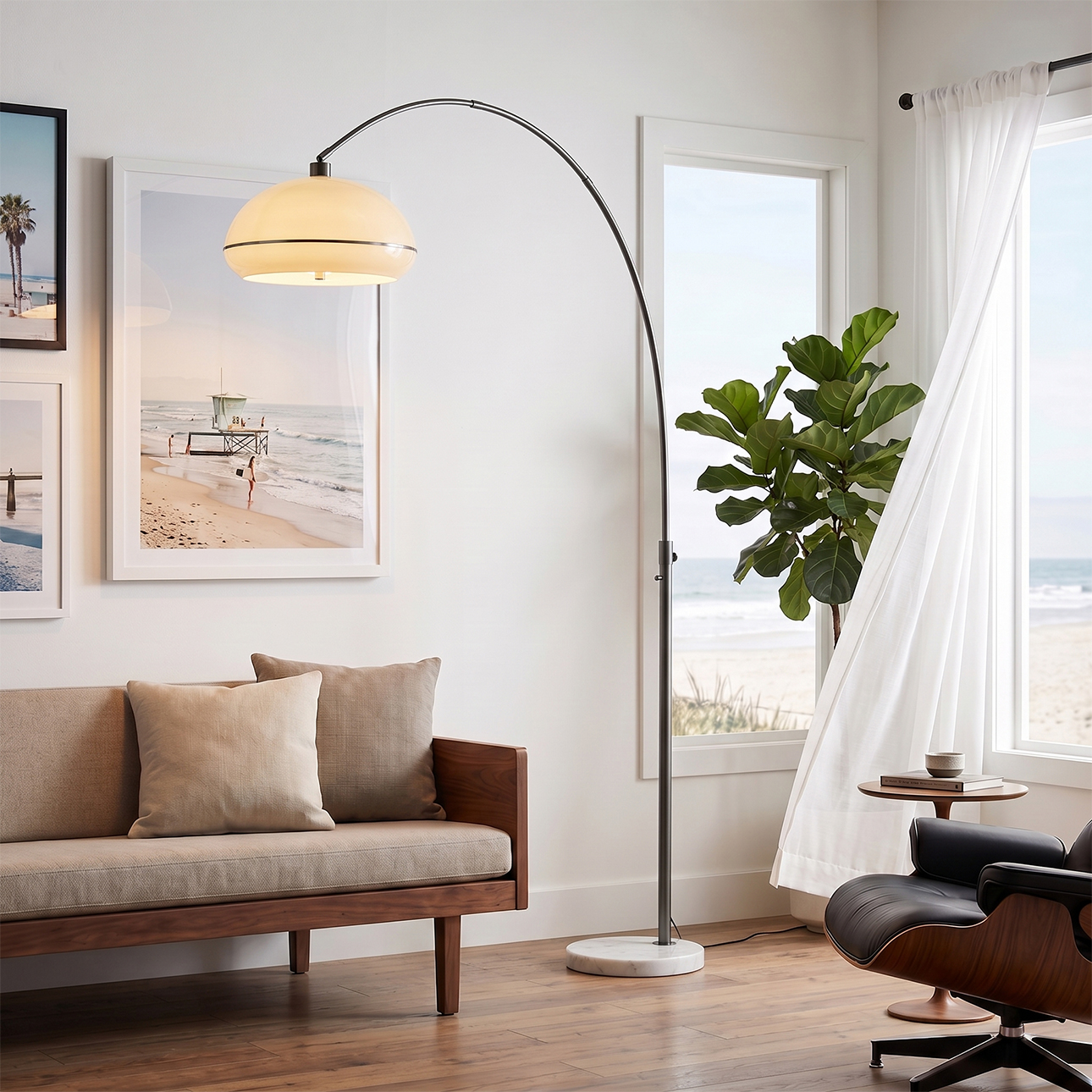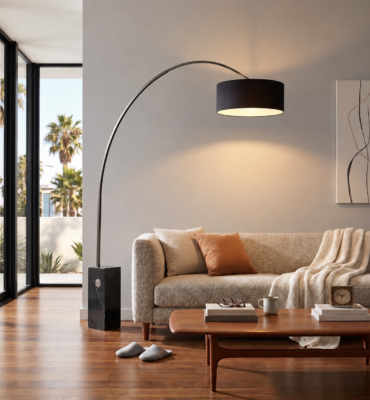
You have a dining table that needs light above it. Or a reading corner that feels too dim. Or a living room where the overhead fixture washes everything in flat, cold light. The obvious answer seems like a pendant. Hang something from the ceiling. Problem solved.
But here is what most homeowners discover after the electrician leaves: a pendant is permanent. It hangs where the wiring goes, not necessarily where you need it. Rearrange your furniture six months later, and the pendant is still lighting the spot where the sofa used to be. An arc lamp, by contrast, follows the furniture.
This comparison is not about which fixture is “better” in the abstract. It is about which one is better for your specific room, your budget, and how you actually live in the space.
An arc lamp is a freestanding floor lamp with a curved arm that extends light over furniture without ceiling installation. A pendant light hangs from the ceiling on a fixed mount. Arc lamps offer portability and zero installation cost. Pendants offer a cleaner visual line and work well in rooms with permanent furniture layouts.
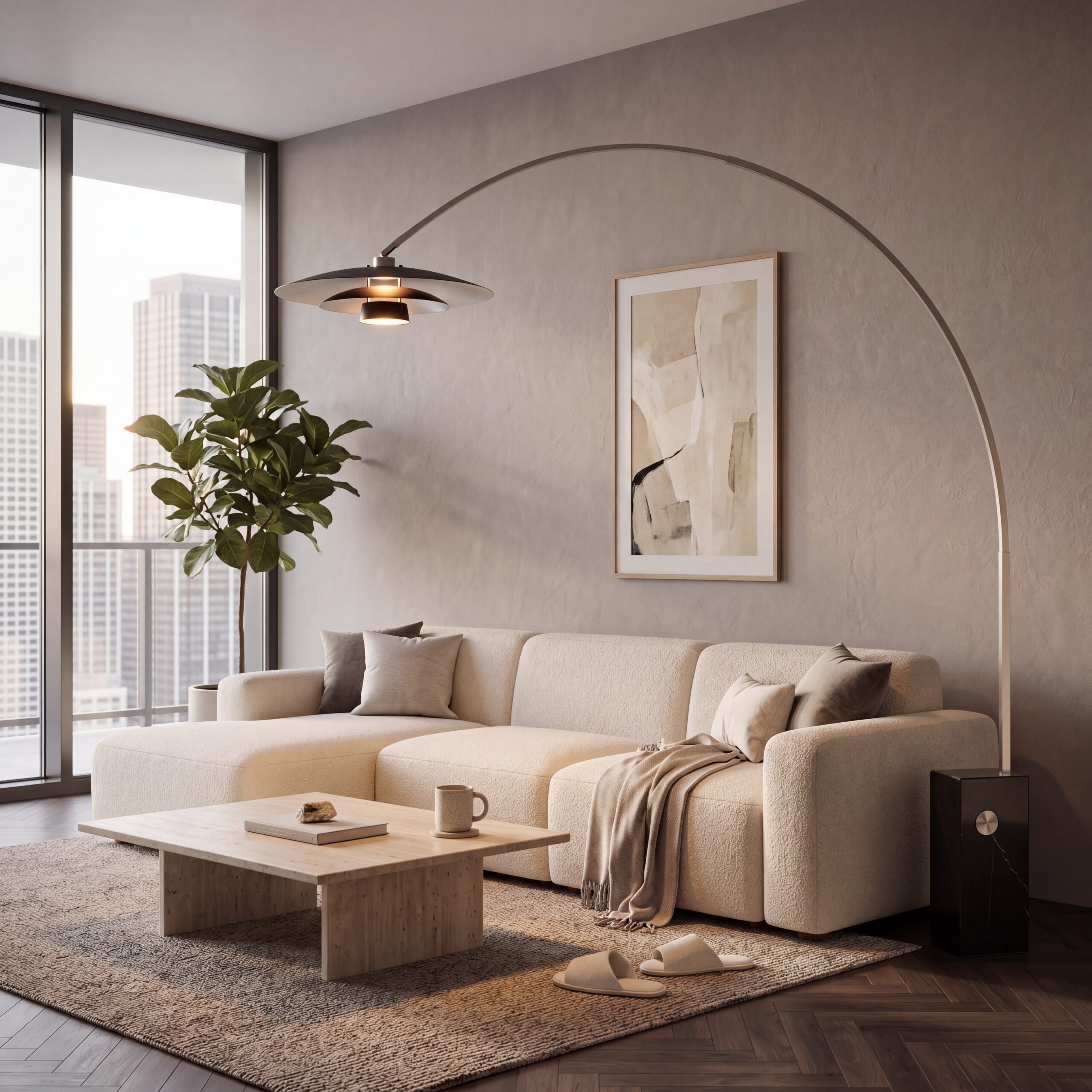
The Fundamental Difference: Fixed vs. Flexible
A pendant light is an architectural fixture. It connects to your home’s electrical system through a junction box in the ceiling. Once installed, it stays where it is unless you hire an electrician to move it. Installation typically runs $150 to $300 for labor alone when you already have a ceiling box in place. If you need new wiring run to a different location, expect $300 to $600 or more depending on how accessible your ceiling cavity is.
An arc lamp is a piece of furniture. You plug it into a standard wall outlet, position it where the light needs to go, and adjust the arc to direct the shade exactly over the surface you want illuminated. If you rearrange the room next season, the lamp moves with the furniture in about 30 seconds.
That distinction alone answers the question for a significant number of homeowners. If you rent, if you move frequently, if you redecorate seasonally, or if your living room serves multiple functions throughout the day, an arc lamp gives you something a pendant physically cannot: the freedom to change your mind.
When a Pendant Light Is the Right Choice
Pendants earn their place in rooms where two conditions are true. First, the furniture layout is permanent. A dining table centered under an existing ceiling box is the classic case. The table is not moving. The chairs are not moving. The light can be fixed because everything below it is fixed.
Second, the visual priority is a clean ceiling line. A pendant hangs from a single point and draws the eye upward. In rooms with high ceilings, exposed beams, or architectural details worth highlighting, a pendant becomes part of the room’s vertical composition. Arc lamps are horizontal by nature. They occupy floor space and command attention at eye level.
Kitchens and formal dining rooms remain the strongest use case for pendant lights. The counter or table position is fixed by plumbing, cabinetry, or room geometry. A row of three pendants over a kitchen island or a single statement pendant over a round dining table looks intentional precisely because the fixture and the surface are locked to each other.
The Flos Arco, arguably the most famous arc lamp ever made, was originally designed in 1962 to solve the dining table problem without a ceiling fixture. That tells you something important: even the designers who perfected the arc lamp acknowledged that the dining table is where pendants have a natural advantage, if the wiring supports it.
When an Arc Lamp Beats a Pendant
Arc lamps outperform pendants in every situation where flexibility matters more than permanence. And in a modern living room, flexibility almost always matters more.
Living rooms with evolving layouts. Most living rooms get rearranged at least once a year. Seasons change. New furniture arrives. A home office corner appears. An arc lamp repositions in minutes. A pendant stays where it was installed, lighting empty floor if the sofa has moved.
Rental apartments and condos. Most leases prohibit electrical modifications. Even where they allow it, you are paying $200 to $400 to install a fixture you will have to remove when you leave. An arc lamp moves with you to the next apartment. No holes. No electrician. No deposit risk.
Rooms without existing ceiling wiring. Older homes, lofts, and converted spaces often lack junction boxes where you need them. Running new wiring can cost $500 or more and involves opening walls or ceilings. An arc lamp delivers the same overhead light effect using an existing wall outlet.
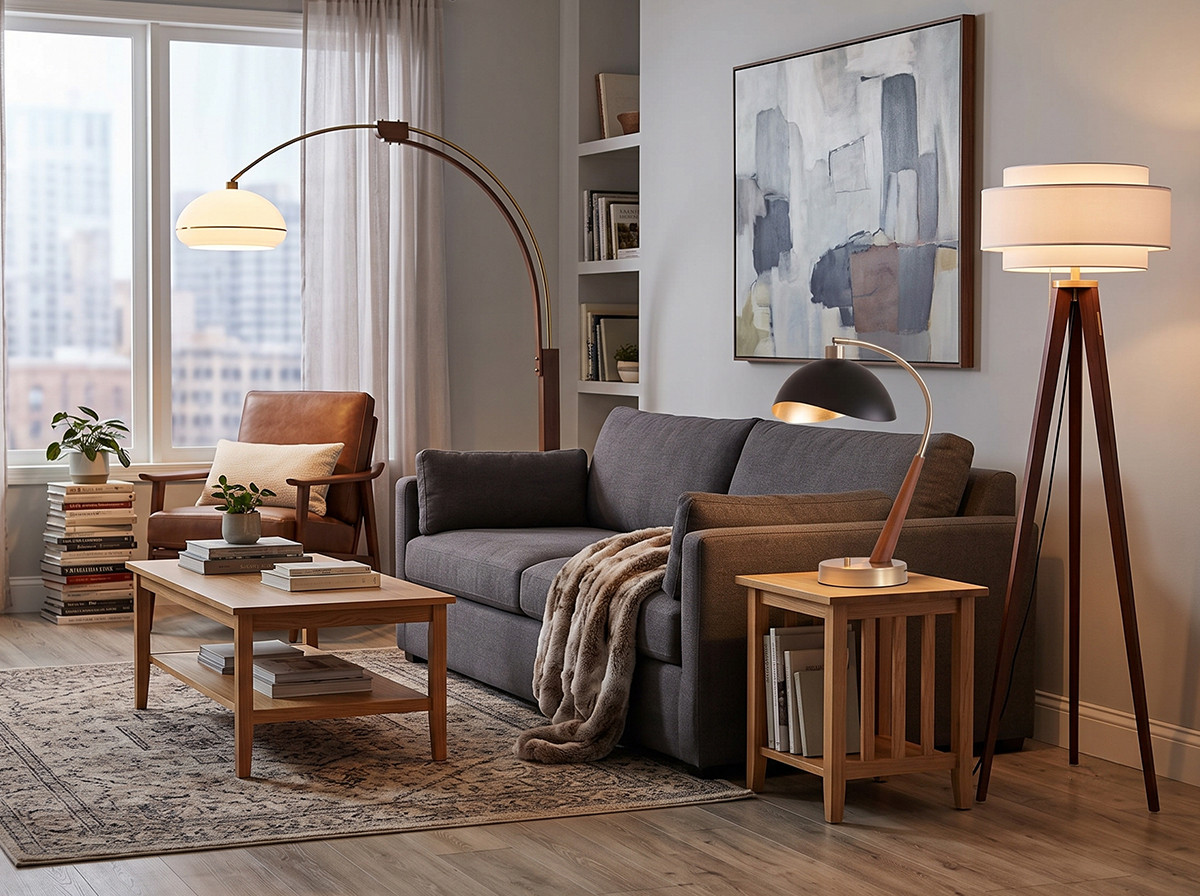
Multi use spaces. A living room that doubles as a home office, a playroom, or an entertainment space needs lighting that adapts. The NOVA Natural Mica 3 Light Arc Floor Lamp has three independently adjustable heads, meaning you can direct one toward the sofa, one toward a work surface, and one toward a conversation area. A single pendant cannot split its attention that way.
Reading and task lighting beside seating. A pendant positioned for ambient fill hangs too high and too far from a reader’s lap to serve as effective task light. An arc lamp curves directly over the back of a sofa or chair, placing the light source within 18 to 24 inches of where a book or device would be held. The NOVA Morelli Arc Lamp at 84 inches tall positions its shade at exactly the right height for reading on a standard sofa.
The Real Cost Comparison
This is where the arc lamp advantage becomes concrete. Here is what each fixture actually costs to own.
Pendant light total cost: Fixture ($100 to $2,000+ depending on design and brand), plus installation labor ($150 to $300 with existing wiring, $300 to $600+ without), plus potential removal cost when you move or redecorate. A quality pendant from a recognized brand installed in a room without existing wiring can easily exceed $1,000 before the first bulb is lit.
Arc lamp total cost: Fixture only. No installation labor. No electrician. No ceiling repair. No removal cost. NOVA arc lamps range from approximately $500 to $800 and include an LED rated for 25,000 hours. At three hours of evening use per day, that LED lasts over 22 years before replacement. The total cost of ownership over a decade is the purchase price and nothing else.
For homeowners on a renovation budget, that math is significant. You can put a premium arc lamp in your living room for less than the installation cost of a mid range pendant in a room without ceiling wiring.
Design Impact: Horizontal vs. Vertical Statement
The aesthetic difference between these two fixtures is worth thinking about carefully because it shapes the entire room.
A pendant makes a vertical statement. It draws the eye upward from the surface it lights to the ceiling it hangs from. In rooms with 10 foot or higher ceilings, this vertical element adds visual height and architectural interest. In rooms with standard 8 foot ceilings, a low hanging pendant can make the space feel compressed.
An arc lamp makes a horizontal and sculptural statement. The sweeping curve of the arm creates a visual arc that spans the room at eye level. It occupies space boldly. A well placed arc lamp becomes the room’s design centerpiece in the same way that a fireplace or a large piece of art does. It is not just a light source. It is furniture.
Mid century modern interiors, in particular, were designed around horizontal lines. Low profile sofas, long credenzas, wide coffee tables. An arc lamp reinforces those proportions. A pendant interrupts them. That is not a flaw of pendants. It is a matter of which design language your room speaks.
Can You Use Both in the Same Room?
Yes, and some of the best designed living rooms do exactly that. The key is assigning each fixture a clear role.
Use a pendant for fixed ambient light in the center of the room or above a dining table within the same open plan. Use an arc lamp for flexible task and accent light beside a seating area. The pendant provides the room’s baseline illumination. The arc lamp provides the directional, adjustable layer that makes the space feel lived in.
The one rule: match color temperature. Both fixtures should output the same Kelvin rating. Mixing a 5000K pendant with a 2700K arc lamp creates a visual clash that undermines everything else in the room. At 2700K warm white, NOVA arc lamps pair cleanly with most residential pendant fixtures set to the same temperature.
Frequently Asked Questions
Can an arc lamp replace a pendant light entirely?
In most living rooms and family rooms, yes. An arc lamp delivers overhead light over sofas, tables, and seating areas without any ceiling installation. The Castiglioni brothers designed the original Flos Arco in 1962 specifically to replace ceiling fixtures. NOVA’s arc lamp collection continues that principle with modern LED technology and contract grade construction.
Is an arc lamp or a pendant better for a dining table?
If your dining table sits directly under an existing ceiling junction box and the table will not move, a pendant is the traditional and effective choice. If the table is not under a ceiling box, or if you rearrange your dining area, an arc lamp delivers the same overhead effect without installation.
Do arc lamps take up too much floor space?
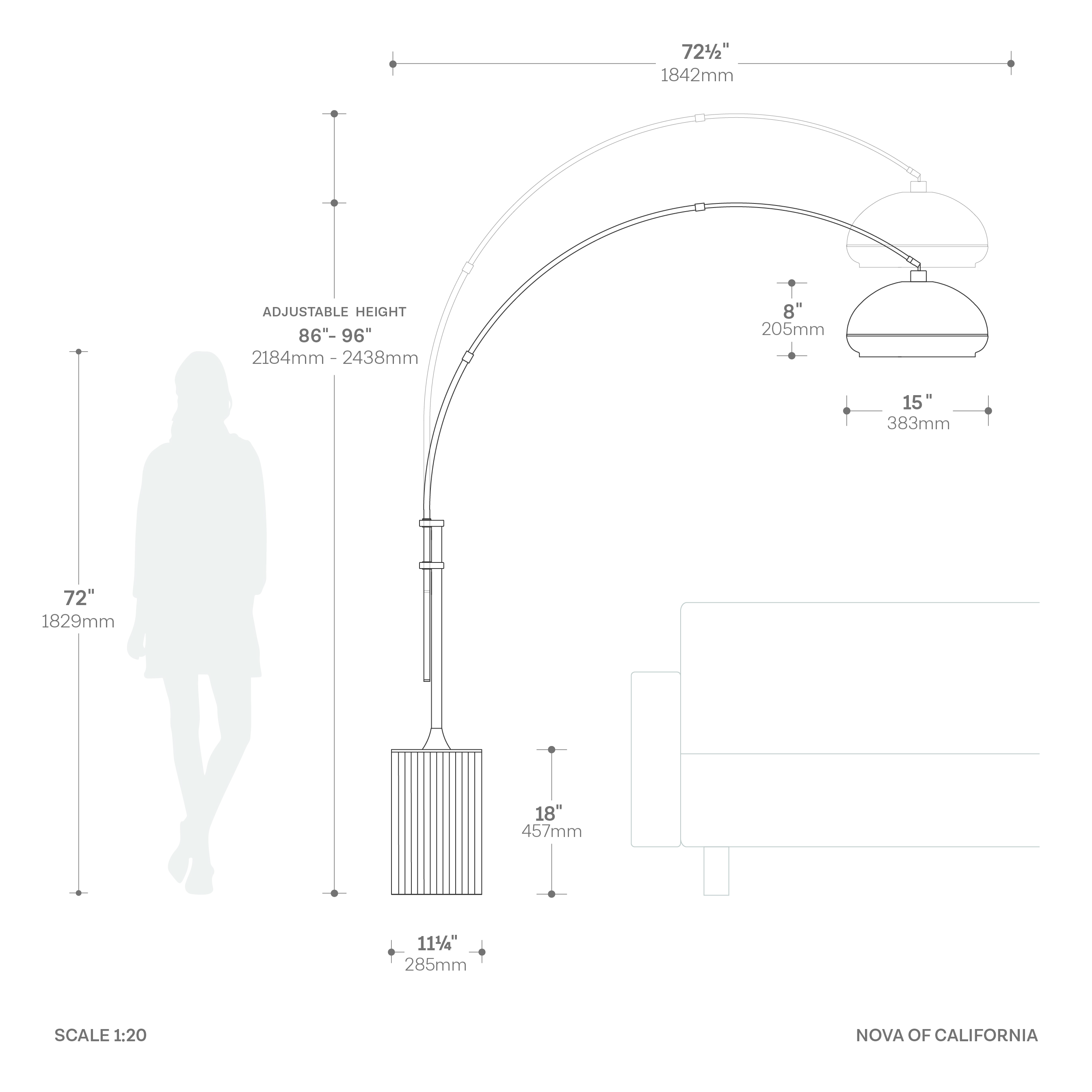
The base of a typical arc lamp occupies a 12 to 14 inch diameter circle on the floor, roughly the same footprint as a small side table. The arc itself extends over furniture rather than beside it, so the lamp uses vertical and horizontal space that would otherwise be empty. In practice, an arc lamp positioned behind a sofa uses no usable floor area at all.
Which costs more over time: an arc lamp or a pendant?
A pendant costs more over time due to installation labor ($150 to $300+), potential removal costs, and ceiling repair if you relocate the fixture. An arc lamp costs the purchase price and nothing else. NOVA arc lamps include an LED rated for 25,000 hours, which eliminates bulb replacement for over two decades of typical use.
Can I use a smart bulb in an arc lamp the way I would in a pendant?
Yes. NOVA arc lamps use a standard E26 socket, which accepts any smart bulb on the market. Screw in a wifi enabled bulb and you get dimming, scheduling, color temperature adjustment, and voice control through any major smart home platform. No rewiring needed.